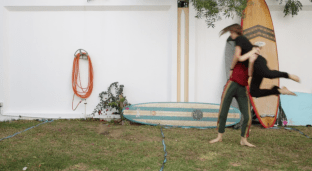
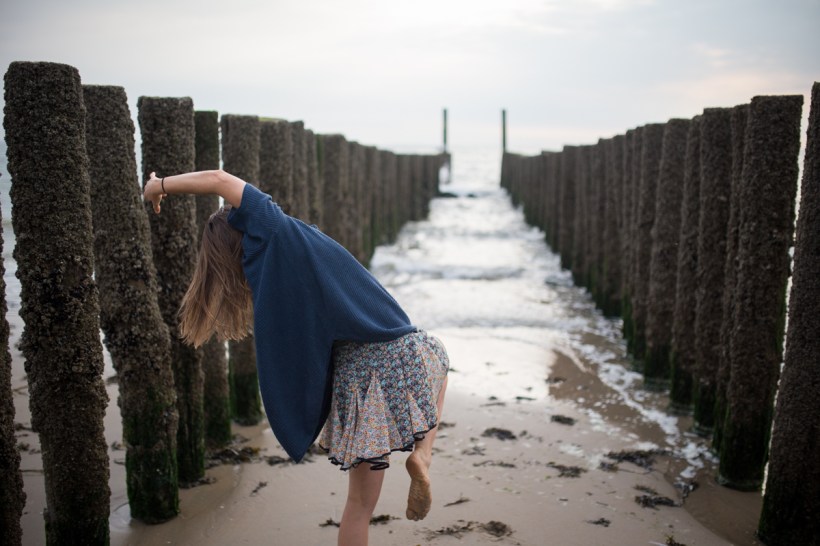
صلـاـي (Play) لعب laeib

screen shot 2019-01-31 at 2.36.42 am
Brief
A video piece exploring elements of play in our environments, with each other and reawakening the different aspects of what it is to ‘play’ as to move whilst opening ourselves up to sensory interactions with a non-anthropogenic and inquisition based research of how we move in our bodies.
Through the 7 minutes of this video- we aim to use the screens to bring in a multidimensionality – incorporating context and use of these in how we play through the different realities- imagination, technological and environmental.
We aim to Playfully explore the body in motion and our environment through sensorial interactions we meet to spend time outside, into the wilderness, engaging with its resources and its challenges, eventually re-awakening what is asleep inside of us. Through Play we can open up our perception and start finding new solutions, learn to trust the intelligence of our body and re-pattern those reflexes that have become dysfunctional over time. We can be re-born playful and then cultivate this quality in every aspects and circumstances part of everyday Life.
“The first thing we must make clear to ourselves is that play is so elementary a function of human life that culture is inconceivable without it” Hans George Gadamer
“Life isn’t going anywhere, we aren’t arriving, we don’t work music, we play” Alan Watts
The music is playful, a journey, un-trying to get somewhere.
A radical act of reconnecting, searching, belonging, exploring, freedom, breaking walls down, nurture, values, finding ourselves, identity, senses, bonding, listening, inquiry, systems, exploring notions of identity.
Nature, our provider and place of birth and death, little do we play with our environment in this anthropogenic society – sapiens a giant leap up the food chain insecure and self centered- reality we must connect !  In an attempt to deconstruct anthropocentrism – using inquiry based research and listening into nature and the authenticity of our movements- whether choreographed or not, sensing in and connecting with our surroundings and each other.
Play in life and in art is an aspect of experience that is common to both those taking part in it and those who look on. Watching or becoming the observer of those playing – brings delight and for those who also remember what it is like to play. Improvised and imaginary situations – a willingness to suspend disbelief and involve oneself in the premise of imagination.
Rules and games – a metaphor of life, should we decide to break them – to play loose and fast and reassert the glorious primacy of free and undirected play – we may feel alive again.
Using contact improvisation, shifting and sharing weight – we start to incorporate progressive movement ideologies – such as testing structure, games, pulling, pushing, throwing, lifting and creating a spontaneous environment for play to occur naturally.
But also incorporating Authentic Movement one person takes on the role of the mover while the other takes on the role of the witness. The mover closes her/his eyes, waits, and then moves in response to body-felt sensations and movement impulses. The witness watches the mover and allows a safe space for the mover to explore and surface deep emotions or memories.
In this practice as artists we aim to ‘listen’ somatically to ourselves, and surroundings and to the energy of the moment.
Grounded in a meditative movement practice involving the detailed sequencing of movement through inner pathways; the investigation of gravity through dynamic shifting of balance and alignment; and the investigation of a spectrum of tempi.
The simplicity of the performance task—to connect/harmonize (body/mind/place) while approaching stillness we can always result in heightened consciousness and a sense of centering for both dancers and viewers
The role of an environmental dancer, and any environmental activist, we propose, to find a practice that habituates ‘listening, playing and moving’ alongside non-anthropocentric values. Authentic Movement is one such practice as well as Contact Improvisation (CI). The basic structure of CI allows for dancers to interact with each other without any allocated dominant dancer occurrences integrated into the form. It involves ‘listening’ with your own body to the other bodies moving in space. CI removes hierarchal positioning from the dance making practice and is not an ‘I’-centred dance methodology. In fact, it shares the same principles of community, sharing, ‘listening’ and reciprocity as an ecosystem. Similar to CI, ecological dance and activism should evolve through a reciprocal connective understanding. Practising CI is an effective method for developing the empathy and ‘listening’ skills needed for ecological dance making and perceptive outdoor relationships.

What is authentic motion and how is it different from movement?

Are we trying to get something so technically perfect or are we trying to truly ‘feel’ what we do with ease and grace. In order to feel we need to step back from the logical working mind; from the one that uses angles and physics to the one that feels the body. The motion vocabulary that uses breathing, sensation, flow, awareness and contact.

Authentic motion is different from movement. Movement is only a result of the motion. It’s the motion is what moves you

The real motion is the process underlying the observable physical shift. The motion set in place is what creates and displays movement.

Welcome to Authentic motion.